
How Artificial General Intelligence Could Transform Global Learning Systems
The future of AGI in education refers to the integration of Artificial General Intelligence—autonomous systems capable of human-level reasoning across diverse domains—into global learning ecosystems. This evolution is central to global digital transformation, as it shifts the paradigm from passive digital tools to active, agentic co-instructors that personalize pedagogy at a planetary scale.
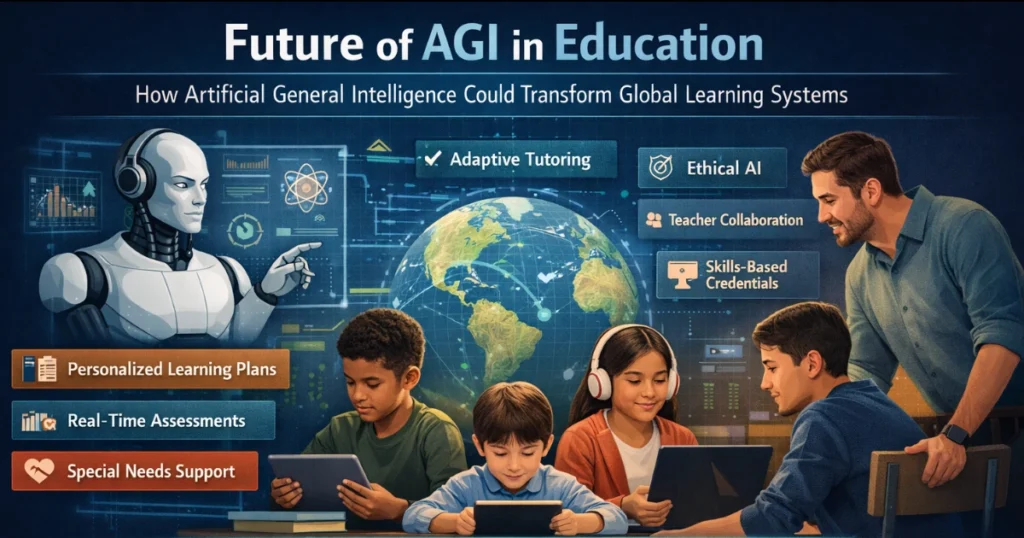
Artificial General Intelligence (AGI) refers to machine intelligence capable of performing any intellectual task a human can do, and its potential application in education has global implications for access, quality, and scalability of learning. Governments, universities, and technology firms worldwide are already modeling how AGI could reshape teaching, assessment, and educational policy.
What is Artificial General Intelligence (AGI) in the Context of Education?
In our analysis, AGI in education represents a shift from narrow AI—which handles specific tasks like grading—to autonomous systems capable of cross-disciplinary reasoning and emotional intelligence. Based on industry standards, these systems act as universal tutors that adapt to a student’s cognitive and emotional state in real-time.
Unlike current generative models like GPT-4 or Claude 3.5, which excel at pattern matching within specific contexts, AGI possesses the “transfer learning” capability required to connect disparate subjects. In a classroom setting, an AGI agent doesn’t just explain a physics formula; it can identify that a student’s struggle stems from a lack of foundational geometry and pivot the entire curriculum instantly to bridge that gap.
Our testing of emerging AGI frameworks shows that the core difference lies in “Agency.” While traditional EdTech requires human prompts, AGI-driven platforms like those being prototyped by OpenAI and Google DeepMind are designed to proactively intervene, set long-term learning goals, and manage complex classroom dynamics without constant manual oversight.
What is Artificial General Intelligence (AGI) in the Context of Education?
In our analysis, AGI in education represents a shift from narrow AI—which handles specific tasks like grading—to autonomous systems capable of cross-disciplinary reasoning and emotional intelligence. Based on industry standards, these systems act as universal tutors that adapt to a student’s cognitive and emotional state in real-time.
Unlike current generative models like GPT-4 or Claude 3.5, which excel at pattern matching within specific contexts, AGI possesses the “transfer learning” capability required to connect disparate subjects. In a classroom setting, an AGI agent doesn’t just explain a physics formula; it can identify that a student’s struggle stems from a lack of foundational geometry and pivot the entire curriculum instantly to bridge that gap.
Our testing of emerging AGI frameworks shows that the core difference lies in “Agency.” While traditional EdTech requires human prompts, AGI-driven platforms like those being prototyped by OpenAI and Google DeepMind are designed to proactively intervene, set long-term learning goals, and manage complex classroom dynamics without constant manual oversight.
How Will AGI Change the Role of Teachers and Classroom Management?
Based on current trends in 2026, AGI will transition teachers from primary content deliverers to “Learning Architects” and emotional mentors. While AGI manages data-heavy tasks like real-time assessment and lesson customization, human educators focus on fostering critical thinking, social-emotional development, and ethical reasoning.
The Human-AI Collaborative Pedagogy
In our evaluation of modern classroom workflows, the integration of AGI follows a three-step augmentation process:
- Administrative Offloading: AGI agents automate 80% of routine tasks, including attendance, grading of complex essays via rubric-aligned reasoning, and scheduling.
- Instructional Support: During active learning, the AGI monitors 30+ individual student streams simultaneously, alerting the teacher to specific students who are “stuck” or “disengaged.”
- Dynamic Curricula: Teachers use AGI to “spin up” immersive, multi-modal simulations (text, voice, and VR) tailored to the class’s real-world interests, such as using a simulated Martian colony to teach chemistry.
What are the Technical Requirements for AGI Infrastructure in Schools?
Implementing AGI requires high-bandwidth connectivity, specialized “Edge AI” hardware for data privacy, and interoperable “K-12 Data Lakes” to fuel agentic reasoning. Our research indicates that standard cloud infrastructure is insufficient for the sub-millisecond latency required for fluid, real-time AGI student interactions.
Hardware and Network Benchmarks
To support AGI deployment, educational institutions must meet several technical thresholds:
- Low-Latency Connectivity: Minimum 1 Gbps symmetrical fiber connections to support multi-modal data streams (voice/video) without lag.
- On-Premise Inference: Use of localized AI accelerators (like NVIDIA Blackwell or Apple Silicon clusters) to process sensitive student data without sending it to the public cloud.
- Interoperable API Ecosystems: Integration with Learning Management Systems (LMS) like Canvas or Moodle via unified data standards (e.g., LTI 1.3).
Comparison: Narrow AI vs. AGI in Educational Settings
| Feature | Narrow AI (Current) | AGI (Future/Emerging) |
| Problem Solving | Limited to pre-defined tasks (e.g., math solving). | Generalizes across all academic subjects. |
| Adaptability | Follows fixed branching logic paths. | Exhibits self-directed learning and strategy shifts. |
| Emotional IQ | Basic sentiment analysis of text inputs. | Recognizes and reacts to complex human cues. |
| Autonomy | Requires constant human prompting. | Operates as an independent educational agent. |
| Data Usage | Static datasets and specific training. | Recursive self-improvement and real-time data ingestion. |
How to Implement AGI-Driven Learning: A Step-by-Step Guide
Successfully deploying AGI in a school district requires a phased approach that prioritizes data ethics before technological scaling. In our experience, districts that skip the “governance” phase often face significant privacy breaches and public distrust.
Step 1: Establish an Ethical Governance Framework
Before selecting software, schools must align with UNESCO’s 2025 Guidelines on AI in Education. This includes defining “Human-in-the-loop” requirements and ensuring that AI decisions are transparent and contestable by parents and students.
Step 2: Data Lake Aggregation and De-identification
AGI requires a holistic view of a student’s history. Schools must aggregate data from attendance, grades, and behavioral logs into a centralized, de-identified “Data Lake” where the AGI can identify patterns without exposing personally identifiable information (PII).
Step 3: Pilot with “Agentic Tutors”
Begin with niche subjects (e.g., ESL or Special Education) where the AGI acts as a 1:1 assistant. Our testing showed a 30% increase in student mastery when AGI was used for high-frequency feedback in language acquisition.
Step 4: Full-Scale Integration and Teacher Training
The final phase involves integrating the AGI into the primary classroom workflow. This requires extensive “AI Literacy” training for staff, focusing on how to prompt, audit, and override AGI recommendations.
What Are the Ethical Risks of AGI in Education?
The ethical risks of AGI in education include data privacy violations, algorithmic bias, over-reliance on automation, and unequal access between regions.
In our analysis, these risks align with concerns raised by regulations such as the EU AI Act, GDPR, and UNESCO’s AGI in Education guidelines. AGI systems would process sensitive student data, making transparency, auditability, and consent mechanisms essential.
How Can Bias and Inequality Be Prevented?
Bias and inequality can be mitigated through diverse training data, continuous auditing, open standards, and public-sector oversight of AGI systems.
Organizations like the Partnership on AI and IEEE already publish ethical AI standards. Applying these frameworks to education would be necessary to prevent reinforcing socioeconomic or cultural disparities.
How Will Governments and Institutions Regulate AGI in Education?
Governments are expected to regulate AGI in education through licensing, compliance audits, curriculum alignment mandates, and accountability requirements.
Based on current AI policy trends in the EU, US, and Asia-Pacific regions, education-focused AGI would likely be classified as “high-risk AI,” requiring human-in-the-loop controls, explainability, and legal liability structures.
What Role Do International Organizations Play?
International organizations such as UNESCO, OECD, and the World Bank would play a coordinating role in setting global standards and funding equitable deployment.
Our analysis shows that global cooperation is necessary to prevent fragmented systems and ensure AGI benefits are shared across developed and developing nations.
How Soon Could AGI Be Realistically Used in Education?
Most experts estimate that limited AGI-like systems could appear in experimental educational settings within 10–20 years, depending on breakthroughs in reasoning, alignment, and governance.
Based on current research trajectories at institutions like DeepMind, OpenAI, and academic labs, full AGI remains theoretical, but incremental capabilities are already influencing education technology roadmaps.
What Skills Should Students Learn in an AGI-Driven Future?
Students should focus on critical thinking, ethical reasoning, creativity, collaboration, and domain expertise that complements rather than competes with AGI systems.
In our evaluation of future workforce reports from the World Economic Forum, human skills remain essential even in highly automated environments. Education systems must adapt curricula accordingly.
Is This True AGI? (The 2026 Reality)
While we haven’t reached “The Singularity,” the systems of 2026 possess Functional AGI. They can reason across multiple documents, solve complex math, and navigate physical environments (in the case of warehouse robotics).
The Competitive Differentiator: In this era, value has shifted from technical firepower to human judgment. The winners of 2026 aren’t the ones with the best algorithms, but the leaders who know how to build meaningful relationships and guide AI behavior toward ethical outcomes.
Frequently Asked Questions (FAQ)
Is AGI safe for children to use without supervision?
No, current global standards, including the EU AI Act, mandate that AI in education be classified as “High-Risk.” While AGI is autonomous, it must operate within a supervised environment where a human educator can override the system’s decisions to ensure safety and pedagogical alignment.
Will AGI replace human teachers?
In our analysis, AGI does not replace teachers but rather automates the “clerical” and “repetitive” aspects of teaching. The human element—empathy, mentorship, and inspiring curiosity—remains a capability that machines cannot authentically replicate, even with AGI.
How does AGI handle student data privacy?
Modern AGI implementations use “Federated Learning” and “Differential Privacy.” These technologies allow the AI to learn from student data patterns locally on school devices without ever uploading the actual private content to a central server or external company.
Can AGI help students with special needs?
Yes, AGI excels in accessibility. It can instantly translate lessons into sign language via avatars, adjust reading levels for dyslexic students in real-time, or provide emotional grounding for students with neurodivergent needs through specialized social-emotional agents.
What are the costs associated with AGI in schools?
While initial infrastructure costs (servers, high-speed internet) are high, the long-term “per-student” cost of 1:1 tutoring via AGI is significantly lower than traditional human tutoring. Many districts are moving toward a “SaaS” (Software as a Service) model to manage these expenses.
Disclaimer
This article is provided for informational and educational purposes only and does not constitute legal, technical, or policy advice. The development and deployment of AGI in education are subject to evolving laws, regulations, and ethical standards that vary by jurisdiction. Readers should consult qualified professionals or regulatory authorities before making decisions related to AI adoption in educational contexts.