AGI Models: Predictions, Evolution, and What Comes Next
Artificial General Intelligence (AGI) models represent a future stage of artificial intelligence, where systems can learn, reason, and adapt across multiple domains, much like human intelligence. No confirmed AGI model exists today. Research labs and technology companies continue to explore general intelligence through advanced AI systems and experimental architectures.
This page explains what AGI models are expected to become, how current AI models relate to AGI research, and what credible signals experts use to predict progress toward general intelligence. All information here focuses on education, analysis, and transparency rather than claims or speculation.
Important note:
AGI models discussed on this page are either theoretical or predictive. Any references to future capabilities reflect research trends, expert opinions, and publicly available roadmaps, not confirmed releases.
What is AGI?
Artificial General Intelligence (AGI) refers to an advanced form of AI that can learn, reason, and solve problems across various domains, mimicking human thought processes. Unlike today’s task-specific AI, AGI focuses on general understanding and the ability to apply knowledge in new situations without retraining.
AGI represents a long-term vision for intelligent systems that adapt, learn continuously, and support humans in complex decision-making while operating under clear ethical and safety guidelines.
What Are AGI Models?
AGI models refer to a theoretical class of artificial intelligence systems designed to understand, learn, and perform tasks across a wide range of domains without being limited to a single purpose. Unlike traditional AI systems that focus on one specific function, AGI models aim to generalize knowledge and apply it flexibly in new and unfamiliar situations.
Most AI systems in use today fall under the category of narrow or task-specific intelligence. These systems can translate languages, generate images, analyze data, or answer questions, but they rely on predefined training and do not truly understand problems outside their learned scope. AGI models, in contrast, are expected to transfer learning between tasks, reason through novel issues, and improve through experience rather than repeated retraining.
Researchers describe AGI models as systems that integrate reasoning, memory, learning, and decision-making into a unified framework of intelligence. This does not mean current models already meet these criteria. Instead, AGI models remain a long-term research goal, shaped by advances in large-scale models, agent systems, and cognitive architectures.
In simple terms, AGI models are not a single product or algorithm. They represent an evolving direction in AI research focused on building intelligence that works broadly, adapts continuously, and operates beyond narrow instructions.
GLM-4.7
GLM-4.7 is a powerful and easy-to-use AI language model that helps with writing, learning, coding, and automation. It delivers fast, clear, and human-like responses, making it ideal for both beginners and professionals. Explore GLM-4.7 to experience smarter and more reliable AI-powered text generation.

Do AGI Models Exist Today? | Current Status of AGI Research
No true AGI models exist yet. Current AI systems, even the most advanced, rely on large datasets, specific tasks, and controlled settings. They cannot learn or reason independently like a human.
Some AI models seem versatile because they can write, code, reason, or analyze images. These are called general-purpose or frontier models, but strong task performance does not necessarily mean they possess general intelligence. They lack long-term memory, real-world awareness, and self-directed goals.
Tech companies and research labs avoid referring to any system as AGI, instead focusing on terms like advanced models or generalist systems. In research, AGI serves as a benchmark to measure progress toward adaptable, human-like intelligence. Today’s AI represents steps forward, but true AGI has not yet arrived.
Current Models Closest to AGI | Advanced AI Systems Leading the Way
While true AGI models do not exist, several advanced AI systems demonstrate features that bring them closer to general intelligence. These models are often referred to as AGI-aligned, generalist AI models, or frontier AI systems, highlighting their ability to handle multiple tasks and adapt to diverse domains.
Large Language Models (LLMs)
LLMs like GPT-4, GPT-4.1, and GPT-5 can understand and generate human-like text, answer questions, write code, and summarize information. They exhibit reasoning capabilities across many topics but rely on pre-trained data and cannot independently learn new skills beyond their training.
Multimodal AI Models
These models, such as Gemini or Claude, process text, images, and sometimes audio together. Multimodal models demonstrate flexibility in understanding and generating information across multiple formats, a step toward the adaptive learning expected of AGI.
Generalist and Agent-Based Systems
Some AI systems are designed to act as agents, plan tasks, and use tools to achieve objectives. Examples include research-oriented agents and open-source frameworks like LLaMA or Mistral. They integrate reasoning, problem-solving, and task execution but still require human oversight and structured environments.
Key Limitations
Despite their advanced capabilities, these models do not possess:
- Persistent memory beyond a session
- True autonomous learning or goal-setting
- Deep understanding of the physical world
- Full ethical reasoning or human-level cognition
These models represent intermediate steps toward AGI rather than fully realized general intelligence. They are invaluable for research, experimentation, and testing future AGI architectures.
Predicted Evolution of AGI Models | GIM Levels and Future Capabilities
Experts predict AI will evolve step by step toward true AGI. The General Intelligence Model (GIM) framework classifies potential AGI development into five levels:
Introduction to GIMs (General Intelligence Models)
General Intelligence Models (GIMs) are a framework for understanding the predicted evolution of AGI systems. They classify AI models by capability levels from GIM-L1 (assisted intelligence) to GIM-L5 (human-level intelligence). GIMs help track AI progress, describe potential features, and explain how future models might learn, reason, and act across multiple domains.
By using the GIM framework, researchers, developers, and enthusiasts can follow AGI development clearly and safely, without assuming that true AGI exists today.
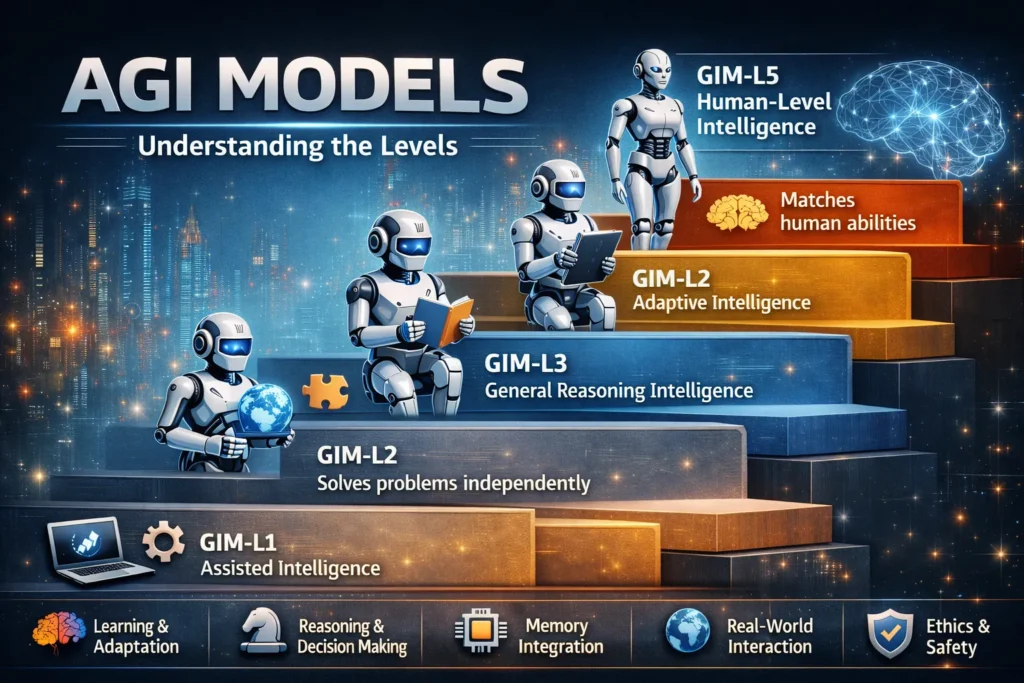
GIM-L1: Assisted Intelligence:
AI helps humans with specific tasks like writing, coding, or analyzing data. It depends on human guidance.
GIM-L2: Adaptive Intelligence:
Models can learn new tasks with little instruction and apply knowledge across areas. They show early reasoning but still need controlled settings.
GIM-L3: General Reasoning Intelligence:
Systems can solve problems, plan, and make decisions in new situations. They combine reasoning, memory, and learning, approaching AGI-like adaptability.
GIM-L4: Autonomous Intelligence:
Models can set goals, act independently, and adapt continuously. They may work across domains, use tools, and interact safely with real-world systems.
GIM-L5: Human-Level General Intelligence (Theoretical):
Represents intelligence matching or exceeding humans across all domains. GIM-L5 remains a long-term goal and benchmark for AGI research.
What are the Key Features of GIM Models? when it arrives.
- Continuous learning and adaptation
- Advanced reasoning across tasks
- Integrated memory and contextual understanding
- Safe interaction with real-world systems
- Ethical alignment and goal-setting
The GIM framework helps track AI progress and anticipate future capabilities as systems move closer to true general intelligence.
Predicted AGI Model Architectures | How GIMs Might Be Built
Experts predict that future AGI models, or General Intelligence Models (GIMs), will use advanced architectures that combine multiple capabilities into unified systems. Understanding these likely designs helps researchers and enthusiasts anticipate how GIM-L1 through GIM-L5 models could function.
Unified Architecture (GIM-U)
GIM-U models integrate language, vision, audio, and reasoning into a single system. These architectures allow multimodal learning and generalization across tasks, forming the backbone for higher-level GIMs (GIM-L3 to GIM-L5).
Agent-Based Architecture (GIM-A)
GIM-A models act as autonomous agents that can plan, execute tasks, and interact with real-world tools. These systems incorporate goal-setting, decision-making, and adaptive learning, making them suitable for GIM-L4 and future GIM-L5 applications.
Cognitive Memory Architecture (GIM-C)
GIM-C models focus on memory integration, contextual reasoning, and continuous learning. They track knowledge over time and improve performance by remembering prior experiences, a key step toward human-level reasoning in GIM-L3 and above.
Modular and Specialized Architecture (GIM-S)
GIM-S models combine general intelligence with specialized domain expertise, such as healthcare, finance, or scientific research. They can solve complex problems by leveraging both general reasoning and domain-specific knowledge.
Key Features Across Predicted Architectures
- Multimodal input and output (text, image, audio, video)
- Continuous learning and adaptation
- Goal-directed reasoning and planning
- Safe tool use and environment interaction
- Ethical alignment and value-sensitive design
These architectures form a predicted blueprint for future AGI models. They show how GIMs could scale from L1 assisted intelligence to L5 human-level intelligence while maintaining flexibility, safety, and broad applicability.
Who Is Likely to Launch the First AGI Model?
No company has released a confirmed AGI model yet. However, several technology organizations are leading research that could eventually produce GIM-L4 or GIM-L5 systems. Understanding their focus helps track the future of AGI development.
OpenAI
OpenAI is at the forefront of AI research, developing large language models (LLMs) and agent systems that form the foundation for higher-level GIMs. Public signals suggest they are preparing for models that approach adaptive and general reasoning intelligence (GIM-L2 to GIM-L4).
If OpenAI Launches AGI, What Name Would They Likely Use?
This article provides informational analysis based on publicly available trends and does not represent official statements, announcements, or confirmations from OpenAI.
OpenAI has not officially announced the release of artificial general intelligence. No public statement confirms that AGI already exists or that it has a finalized product name. Still, many researchers and users ask an important question: if OpenAI launches AGI in the future, what name would they likely choose?
The answer depends on OpenAI’s past naming behavior, public communication style, and approach to safety and regulation.
OpenAI Avoids the Term “AGI” in Product Names
OpenAI rarely uses the term AGI in public-facing product branding. Even when models show strong reasoning or broad capabilities, OpenAI describes them as more capable, general-purpose, or advanced reasoning systems.
Using the word “AGI” directly could create regulatory pressure, public misunderstanding, and unrealistic expectations. Because of this, OpenAI would likely avoid naming a product “AGI,” even if its capabilities approach that level.
Most Likely Naming Pattern: GPT-Based
If OpenAI releases an AGI-level system, it would most likely appear as an advanced GPT model, not a separate AGI product.
Commonly expected examples include:
- GPT-6
- GPT-X
- GPT Omni
- GPT Generalist
This keeps brand continuity and avoids bold claims.
Google DeepMind
DeepMind focuses on multimodal systems, reasoning architectures, and agent-based AI. Their research aligns with GIM-L3 to GIM-L4, emphasizing unified intelligence, planning, and problem-solving across multiple domains.
Anthropic
Anthropic prioritizes safe and interpretable AI. Their models aim to incorporate reasoning, alignment, and ethical frameworks, supporting GIM-L2 to GIM-L3 development with a focus on responsible AGI evolution.
Other Research Labs
Organizations such as Meta AI, Microsoft, and smaller AI labs are contributing to generalist AI research. While they may not lead initial AGI deployment, their work supports GIM-L1 to GIM-L3 capabilities in specialized or open-source models.
How AGI Models May Be Named in the Future?
When AGI Models are developed, companies are likely to avoid using the term “AGI” publicly. Instead, naming will focus on capabilities, versioning, and general intelligence alignment, which aligns well with the GIM (General Intelligence Model) framework.
Likely Naming Patterns
- GIM-L1, GIM-L2, … GIM-L5 – Denotes capability levels from assisted intelligence to human-level intelligence.
- GIM-U (Unified Models) – Highlights multimodal, all-in-one architectures.
- GIM-A (Agent Models) – Emphasizes autonomous task execution and planning.
- GIM-C (Cognitive Models) – Focuses on memory, reasoning, and learning.
- GIM-S (Specialized General Models) – Combines general intelligence with domain-specific expertise.
Research vs Commercial Naming
- Research Labs: Likely to use capability-focused names like GIM-L3 or GIM-U for clarity and academic reporting.
- Tech Companies: May adopt branded or versioned names (e.g., GPT-5, Gemini, Claude) while internally mapping to GIM levels.
- Public Marketing: Terms like Advanced General Intelligence, Frontier AI Models, or GIM-based Platforms will likely appear to avoid regulatory concerns and public misinterpretation.
Why GIM Naming Matters
- Provides a neutral and transparent system to track AGI progress.
- Ensures consistency across research, products, and public communications.
- Allows users and developers to understand capabilities clearly without assuming AGI exists yet.
Risks, Limits, and Open Questions for AGI Models
Although GIMs (General Intelligence Models) provide a framework for predicting AGI capabilities, there are significant risks, limitations, and uncertainties to consider.
Key Risks
- Safety and Alignment: Future GIM-L4 and GIM-L5 systems could act unpredictably if not properly aligned with ethical and human-centric goals.
- Misuse: Advanced models could be exploited for harmful purposes, including misinformation, cyberattacks, or autonomous decision-making errors.
- Regulatory Challenges: Rapid development may outpace government policies, creating gaps in oversight for high-level AGI systems.
Current Limits
- Learning Constraints: Even advanced GIMs cannot yet perform continuous self-directed learning across all domains.
- Reasoning and Adaptation: Current models still struggle with deep reasoning, real-world understanding, and long-term planning.
- Human Cognition Gap: Models lack true consciousness, intuition, and emotional understanding, making human-level intelligence theoretical for now.
Open Questions
- Timeline Uncertainty: When GIM-L4 or GIM-L5 will emerge remains highly speculative.
- Ethical Governance: How should developers ensure alignment with human values at scale?
- Transparency: How will companies disclose capabilities without exaggeration or creating public panic?
- Measurement: What benchmarks will reliably indicate progress toward AGI?
Understanding these risks and limits ensures that research and development of GIMs remain responsible, transparent, and aligned with societal needs. Experts emphasize caution, ongoing evaluation, and multi-stakeholder governance as GIMs evolve.
Realistic AGI Timelines
Predicting when AGI models will reach higher GIM levels is highly uncertain. Experts provide ranges rather than exact dates, reflecting the complexity and research challenges involved.
Short-Term (1–3 Years)
- Expected progress in GIM-L1 to GIM-L2 capabilities
- Advances in assisted and adaptive intelligence, multimodal learning, and generalist task handling
- Focus remains on improving current AI models, reasoning, and agent-based experimentation
Medium-Term (5–10 Years)
- Potential emergence of GIM-L3 systems with general reasoning, planning, and memory integration
- Early experiments in autonomous intelligence, tool use, and multi-domain learning
- Research emphasizes safety, alignment, and scalable architectures
Long-Term (10+ Years)
- Theoretical development of GIM-L4 to GIM-L5 models, approaching human-level general intelligence
- Systems may set independent goals, adapt continuously, and interact dynamically with real-world environments
- Significant regulatory, ethical, and technical hurdles remain before deployment
Important Note:
Timelines vary widely between experts and organizations. These predictions are based on research trends, current capabilities, and public signals, not confirmed releases.
Conclusion & Key Takeaways
AGI models remain a theoretical and predictive concept, with true general intelligence yet to be realized. The GIM (General Intelligence Model) framework provides a structured way to understand potential AGI capabilities, from GIM-L1 assisted intelligence to GIM-L5 human-level intelligence.
Key Points
- No confirmed AGI exists today, but current AI models like LLMs, multimodal systems, and agent-based AI represent steps toward GIM-L3 and beyond.
- GIM-level naming conventions help track capabilities, predict future models, and maintain clarity across research and public communication.
- Predicted architectures such as GIM-U, GIM-A, GIM-C, and GIM-S illustrate how future AGI models may integrate reasoning, memory, and autonomy.
- Risks, limits, and open questions highlight the importance of safety, ethical alignment, and regulatory oversight in AGI development.
- Monitoring progress through research publications, model releases, benchmarks, and community insights allows users to stay informed about emerging GIM-level capabilities.
By following the GIM framework, enthusiasts, researchers, and organizations can understand the evolving landscape of AGI, anticipate future developments, and engage responsibly with the technology as it approaches higher levels of intelligence.
FAQs About AGI Models and GIMs
1. What are AGI models?
AGI models, or Artificial General Intelligence models, are theoretical AI systems designed to learn, reason, and perform tasks across multiple domains similar to human intelligence. True AGI does not exist yet.
2. What is a GIM?
GIM stands for General Intelligence Model. It is a framework to classify predicted AGI capabilities into levels, from GIM-L1 (assisted intelligence) to GIM-L5 (human-level intelligence).
3. Are there any confirmed AGI models today?
No. Current AI models like LLMs, multimodal systems, and agent-based AI show advanced capabilities but are still narrow or generalist intelligence systems, not true AGI.
4. Who is likely to launch the first AGI model?
Leading research labs include OpenAI, DeepMind, and Anthropic. Other companies and research organizations also contribute to generalist AI, but no confirmed AGI release has occurred.
5. How will AGI models be named?
Companies are expected to use GIM-style naming internally (e.g., GIM-L1 to GIM-L5) and branded names publicly (e.g., GPT-5, Gemini, Claude). Names often reflect capability levels or architectures like GIM-U, GIM-A, or GIM-C.
6. What are the main risks of AGI?
Risks include safety and alignment issues, misuse, ethical concerns, and regulatory challenges. Future models must be developed responsibly with careful oversight.
7. How can I track AGI progress?
Track AGI by following research publications, model releases, benchmarks, AI communities, and company roadmaps. Pay attention to improvements aligned with GIM-L2 to GIM-L5 levels.
8. When will AGI arrive?
Timelines are uncertain. Short-term progress is expected for GIM-L1 to GIM-L2, medium-term for GIM-L3, and long-term for GIM-L4 to GIM-L5, possibly 10+ years, depending on breakthroughs and research pace.