
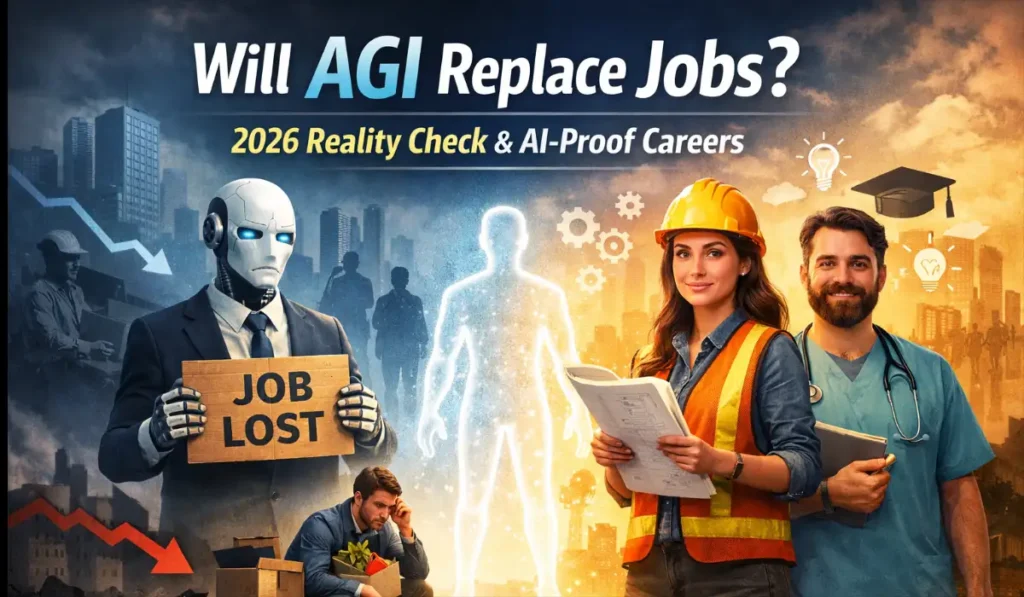
Will AGI Replace Jobs? The 2026 Bottom Line: While Artificial General Intelligence (AGI) is transforming the workforce, it is not “deleting” jobs. Instead, it is automating routine tasks, shifting human roles toward empathy-driven and high-dexterity careers. By 2026, the most secure jobs are those in skilled trades, healthcare, and strategic leadership, where AI cannot replicate human judgment.
Let’s be honest. If you have scrolled through your news feed lately, you have probably seen the headlines. Everyone is talking about Artificial General Intelligence (AGI) and how it might “delete” the workforce.
It is normal to feel anxious. The idea of a machine that can think, learn, and reason like a human is scary. You might be asking yourself, ‘Is my career secure?‘ Do I need to know coding right now? Is it too late to pivot?
The short answer? No, it is not too late. While the landscape is changing fast, the “robots taking over” story is often blown out of proportion. Let’s break down the actual 2026 data and the AI-Proof Jobs you can bank on.
What is AGI, Anyway? (And Why It’s Not Here Yet)
First, we need to clear up the confusion between the tools we have now and the “Sci-Fi” future. Most of the AI you use today—like ChatGPT, Gemini, or the recommendation algorithm on Netflix—is called Narrow AI.
- Narrow AI: Really good at one specific thing (writing emails, generating images, or driving cars). But it cannot do all three at once. It cannot wake up and decide to learn how to cook an egg.
- AGI (Artificial General Intelligence): The hypothetical future AI that can do anything a human can do. It could learn new skills on its own, reason through complex problems, and adapt to any situation without training.
Here is the 2026 reality check: We are not there yet. While tools are getting smarter every day, true AGI is still a goal, not a finished product sitting in your HR department.
Will AGI Replace Jobs? The Transformation Data
Recent 2025 – 2026 reports from Goldman Sachs and the World Economic Forum (WEF) suggest that while AI could impact 300 million jobs globally, the majority of that impact is augmentation, not replacement.
In fact, the WEF’s Future of Jobs Report 2025 projects that while 92 million jobs may be displaced, 170 million new roles will be created—a net gain of 78 million opportunities.
For most professionals, AI won’t take their job; it will take over the repetitive tasks within their job. In 2026, we are seeing the rise of “Agentic AI”—systems that don’t just answer questions but actually execute workflows.
- Writers & Marketers: Use AI agents to handle the 80% “grunt work” of SEO research and initial drafting. Humans provide the 20% “soul,” cultural nuance, and editorial fact-checking.
- Software Engineers: AI handles syntax and basic debugging. Human engineers are shifting toward “System Architects,” focusing on how different AI agents interact and ensuring security.
- Customer Experience: AI agents resolve 90% of routine tracking and refund requests. Humans are reserved for “High-Stakes Resolution”—handling complex emotional crises that require empathy and lateral thinking.
The Reality: Transformation, Not Just Replacement
So, if AGI isn’t here yet, why is everyone worried? Because even “Narrow AI” is powerful enough to change how we work.
Recent reports from late 2025 give us a clearer picture. Major financial institutions like Goldman Sachs have estimated that AI could impact hundreds of millions of jobs. However, they clarify that “impact” does not mean “replace.”
The World Economic Forum (WEF) has pointed out that while routine roles are declining, new roles are popping up. We need people to manage these systems, ensure they are ethical, and apply human judgment to AI outputs.
List of 7 AI-Proof Jobs for 2026
If you want to future-proof your career, you need to target roles that require skills AI is terrible at: Empathy, Physical Dexterity, and Complex Strategic Judgment.
Here are the careers proving to be the most resilient in 2026:
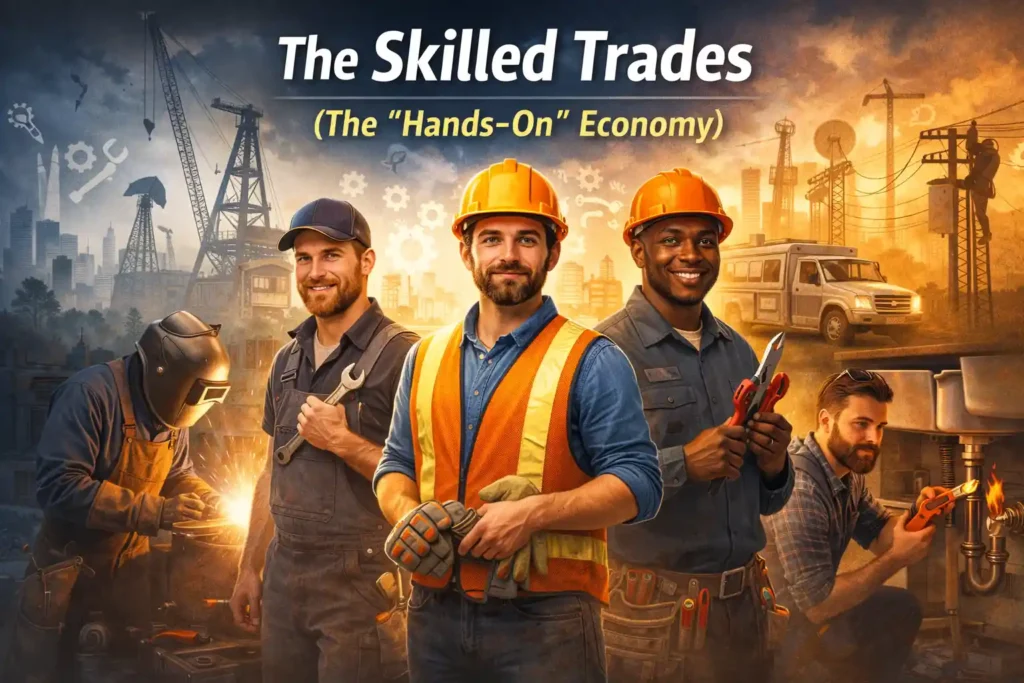
1. The Skilled Trades (The “Hands-On” Economy)
Robots are still clumsy. They cannot easily navigate a cluttered construction site, squeeze into a crawl space, or fix a leaky pipe under a custom sink.
- Top Roles: Electricians, Plumbers, HVAC Technicians, Chefs.
2. Healthcare Providers
An AI can analyze an X-ray faster than a human, but it cannot deliver a cancer diagnosis with compassion. It cannot comfort a frightened child or read the subtle physical cues of a patient in pain.
- Top Roles: Nurses, Occupational Therapists, Surgeons, and Elderly Care Specialists.

3. Specialized Mental Health Professionals
Therapy isn’t just about giving advice; it’s about building a deep, trusting human connection over time. AI chatbots can offer coping mechanisms, but they cannot replace the “therapeutic alliance.”
- Top Roles: Psychologists, Social Workers, Counselors.
4. Creative Strategists & Directors
AI can generate a logo in seconds. But it cannot sit in a boardroom, read the tension in the room, understand cultural nuance, and negotiate a brand strategy that connects with human emotions.
- Top Roles: Creative Directors, Brand Strategists, PR Managers.
5. Education & Mentorship
Teaching is more than reciting facts. It involves motivation, conflict resolution, and social-emotional learning. AI can be a tutor, but it cannot be a mentor.
- Top Roles: Special Education Teachers, Early Childhood Educators, Corporate Trainers.

6. AI Ethics & Compliance Officers
As companies adopt AI, they face massive legal and reputation risks. They need humans to audit these systems, ensure they aren’t biased, and keep the company out of court.
- Top Roles: AI Auditors, Data Privacy Officers, Legal Compliance Managers.
7. Cybersecurity Specialists
Hackers are using AI to create smarter attacks. We need human experts who can think like a hacker to defend critical infrastructure.
- Top Roles: Information Security Analysts, Ethical Hackers.
Important Note: For additional context on which jobs are considered “safe” from automation, watch the video below, which breaks down specific roles that are likely to survive the AI transition:
Your 2026 Action Plan: Prepare, Don’t Panic
Focus on “Human-Only” Skills: Critical thinking, resilience, and leadership are now the “Hard Skills” of the new economy.
Become an “AI Orchestrator”: The most valuable worker in 2026 is the one who knows how to lead a team of AI agents to do 10 hours of work in 1 hour.
Audit Your Task List: If 90% of your day is data entry or scheduling, start pivoting toward “Process Design” or “Relationship Management.”
1. Master “Prompt Engineering” Basics
You don’t need a Computer Science degree. You just need to know how to talk to these tools.
- Action: Spend 30 minutes a day using a leading AI tool. Ask it to summarize a long PDF, draft an email, or plan your week.
2. Take a Short Course
You need a certificate that proves you aren’t afraid of tech.
- Recommendation: Look for “Generative AI for Everyone” courses on platforms like Coursera or DeepLearning.AI.
3. Double Down on “Soft Skills.”
Since AI is taking over technical tasks, your human skills are now your premium assets. Focus on Communication, Leadership, and Emotional Intelligence.
Frequently Asked Questions (FAQ)
Will AI replace human jobs completely by 2030?
Unlikely. Most experts predict a shift rather than a total replacement. While routine and data-entry jobs will decrease, jobs requiring human interaction, physical skill, and strategic oversight will grow.
Is it safe to learn coding in 2026?
Yes, but the focus has changed. Don’t just learn “syntax” (which AI can do). Learn software architecture, system design, and problem-solving. You will spend less time typing code and more time reviewing what the AI writes.
Which industry is the most “AI-Safe”?
The Skilled Trades (Plumbing, Electrical work) are currently considered the safest because robotics technology lags far behind software AI.
Final Thoughts
Will AGI replace jobs? Yes, it will replace tasks. It will change job descriptions. It will make some old roles obsolete.
But history shows us that technology creates more opportunities than it destroys. The calculator didn’t kill mathematics; it allowed mathematicians to solve harder problems.
The future belongs to the curious. Don’t let fear paralyze you. Open a new tab, start playing with these tools, and make them work for you. You’ve got this.